
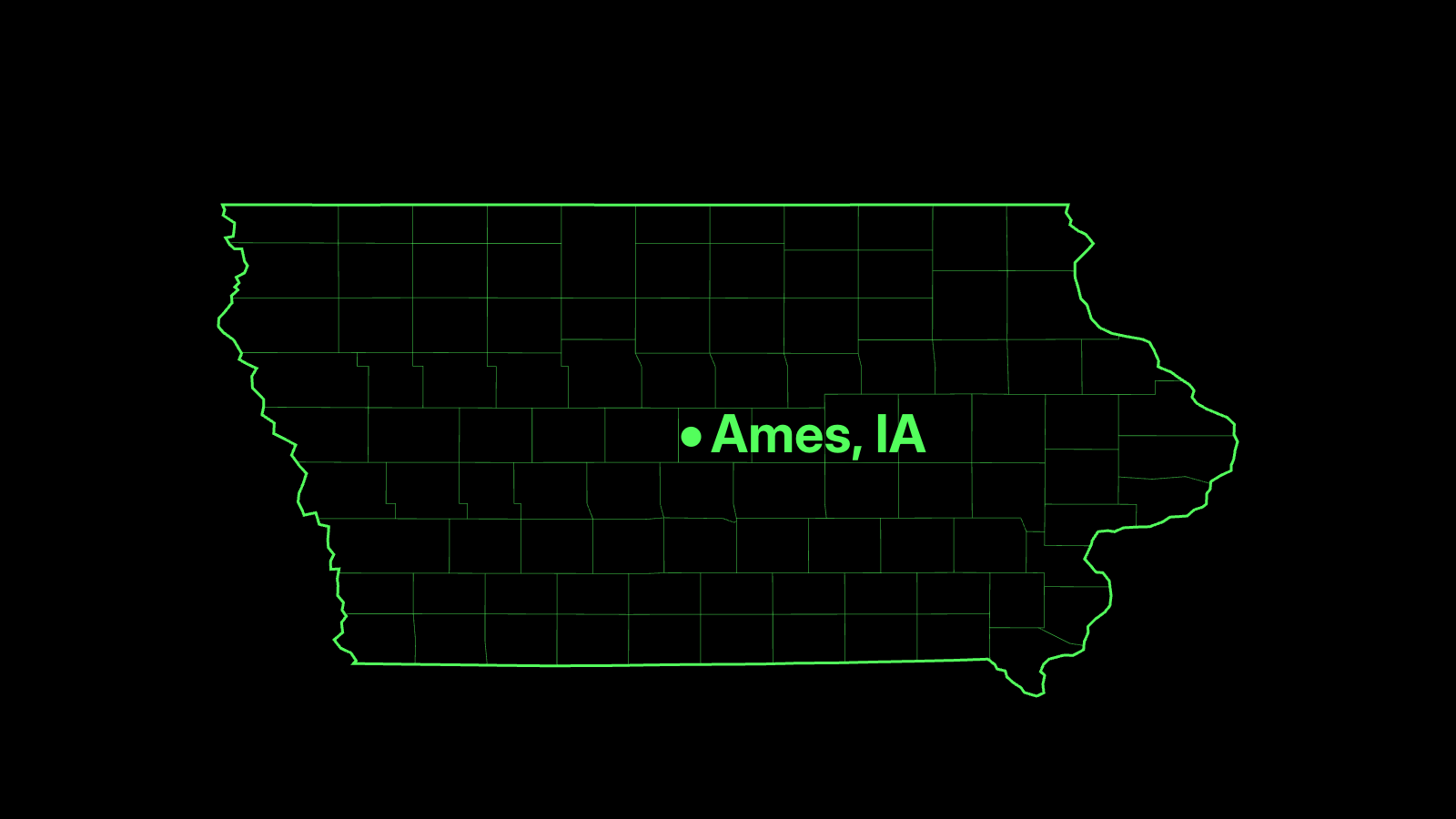
Ames,
Iowa
A college town with genuine affordability and strong schools, though the university economy keeps wages modest for non-academic workers. Ames offers a high quality of life at a reasonable price — if you can find your footing in a market shaped by students.
American Dream Index
Ames, IA
Median Income
$52,400
Median 3BR
$285,000
Rent 2BR
$1,050/mo
Unemployment
2.8%
Population
66K
Median HH Income
$52,400
Median 3BR Price
$285,000
ADI Score
66
Pop. Growth/yr
+0.8%
Unemployment
2.8%
City Scorecard
Hover any card for detailed analysis. Grades reflect the default 2-adult, 2-child median-income household.
Housing Affordability
Home prices are moderate relative to national norms, but elevated compared to local wages.
Housing Affordability — B
The median 3BR home in Ames runs around $285,000, putting the price-to-income ratio near 5.4x — above the historically healthy 3x benchmark. The rental market is student-driven, keeping 2BR rents around $1,050/month. Homeownership is achievable for dual-income households but a stretch for single earners at median wage.
Jobs & Economy
Low unemployment, but wages skew modest outside Iowa State University and USDA research roles.
Jobs & Economy — C+
Ames benefits from a diversified employer base anchored by Iowa State University, the USDA National Animal Disease Center, and growing biotech. The unemployment rate is well below the national average at 2.8%. However, median household income of $52,400 lags behind comparable college towns, partly because the student population depresses household income figures and retail/service wages remain low.
Schools
Ames Community School District is one of Iowa's highest-rated systems, a major family draw.
Schools — A-
Ames schools consistently rank among Iowa's top districts, with high graduation rates, strong AP participation, and above-average test scores. The presence of Iowa State University enriches extracurricular and academic programming. Families with school-age children often cite Ames schools as the primary reason they chose the city over larger Iowa metros.
Healthcare
Access is solid for a small city, with Mary Greeley Medical Center and proximity to Des Moines specialists.
Healthcare — B+
Mary Greeley Medical Center is a full-service regional hospital, and several clinics serve the ISU community. Individual healthcare premiums average around $340/month. Serious or specialized care often requires a 45-minute drive to Des Moines, which is a real consideration for families with complex medical needs. Overall, routine healthcare access is well above average for a city of this size.
Childcare
Infant care around $1,020/month is better than coastal cities but still a significant budget burden.
Childcare — C+
Childcare costs in Ames are meaningfully lower than national averages, but at roughly $1,020/month for infant care, they still represent about 23% of the median household income — well above the 7% affordability benchmark. ISU's Child Development Lab and several cooperative childcare options provide some alternatives. Availability can be tight given demand from faculty and student families.
Safety
Ames is a genuinely safe small city with a crime index well below national averages.
Safety — A-
With a crime index of 28 (lower is safer), Ames ranks among Iowa's safest cities. Violent crime is rare and property crime is modest relative to its size. The college-town dynamic can lead to occasional noise and property incidents near campus, but overall the city is considered very safe for families. Community policing relationships are strong.
Walkability & Transit
Campus and nearby neighborhoods are walkable, but most of Ames requires a car.
Walkability & Transit — C
Walkability in Ames scores about 48 out of 100, reflecting its Midwest car-dependent layout outside the ISU campus core. CyRide, the city-university bus system, is surprisingly robust and free for ISU students, covering most of the city. Biking infrastructure is better than most Iowa cities. Families living away from campus should expect daily car dependency.
Culture & Lifestyle
Iowa State brings arts, sports, and dining that punch above the city's population weight.
Culture & Lifestyle — B
Ames has a surprisingly vibrant cultural scene for a city of 66,000, driven almost entirely by Iowa State University. Hilton Coliseum hosts Big 12 sports and national acts; the Octagon Center for the Arts and Stephens Auditorium anchor the cultural calendar. The restaurant scene is eclectic with good international options. However, nightlife and entertainment options thin out significantly during summer and university breaks.
Why people are moving here
Exceptional Public Schools
The Ames Community School District is consistently one of Iowa's top-performing districts, offering families strong K-12 education without paying private school tuition. High graduation rates and robust academic programming make it a compelling reason for families with children to consider Ames over larger but lower-performing districts.
Safe, Small-City Quality of Life
Ames offers an unusually low crime rate, clean infrastructure, and abundant green space and trails for a city its size. The combination of safety, parks, and a walkable university core creates a livable environment that families frequently cite as a hidden gem compared to larger Iowa metros. Life here feels unhurried without feeling stagnant.
Housing Still Within Reach
While not as cheap as rural Iowa, Ames home prices remain far below national averages and well below comparable university towns. A family that can sustain a dual income of $80,000–$100,000 combined can realistically purchase a solid 3-bedroom home within a few years of saving. The market has shown restraint compared to Sun Belt university cities.
Knowledge Economy Anchor
Iowa State University, the USDA Agricultural Research Service, and a growing cluster of ag-biotech and data companies provide stable, recession-resistant employment. The university itself is one of the top employers in central Iowa, and spillover startup activity is growing. This base provides more employment stability than many comparably sized Midwest cities.
What the boosters don't mention
Wages Don't Match Living Costs
Ames's wage structure is heavily influenced by the university sector and lower-wage retail and food service jobs catering to students. Median household income of $52,400 makes the $285,000 median home price a genuine stretch, especially for single-income families or those without university-linked employment. The income picture can be misleading due to the large student population depressing averages.
Car Dependency Outside Campus
Beyond the ISU campus and a few adjacent neighborhoods, Ames is a car-dependent Midwest city. Families without reliable vehicles will find daily logistics challenging, and the cost of car ownership adds meaningfully to the real cost of living. While CyRide is helpful, it doesn't fully compensate for the lack of dense, walkable commercial corridors throughout the city.
Seasonal and University-Driven Economy
The city's cultural and economic energy is heavily tied to the academic calendar. Restaurants thin out, housing vacancy spikes, and the general vitality of downtown diminishes during summer months. Families not connected to the university may find the boom-bust rhythm of a college town disorienting or limiting in terms of year-round amenities.
Limited Specialist Healthcare Nearby
While routine care is adequate, families with chronic conditions or specialized healthcare needs will regularly need to travel 45 minutes to Des Moines for specialist access. This is a real time and cost burden, particularly for families with young children or elderly members. The medical infrastructure, while functional, simply cannot match what's available in larger metros.
The Bottom Line
Ames is a genuinely good place for families who prioritize school quality, safety, and a manageable cost of living over high wages and urban amenities. The sweet spot here is a household connected to Iowa State or the ag-tech sector earning $75,000+ combined — those families will find Ames a legitimate path to homeownership and financial stability. Working-class families in retail or food service will face a tighter squeeze, as the university economy keeps wages modest while lifting housing costs above rural Iowa norms.
Ames ZIP Code Map
Each hexagon represents a ZIP code. Hover for details. Source: FHFA HPI metro-level estimates, HUD FMR, 2024 Q4.
Price Range
Most Affordable ZIPs
Retirement Savings Projection
Saving for retirement in Ames is achievable but requires deliberate planning given that median incomes are suppressed by the student population and university wage scales. Those in stable professional or government-adjacent roles at ISU or USDA have access to excellent defined-benefit or 403(b) plans that significantly improve retirement outcomes.
These projections assume consistent income growth and no major cost-of-living disruptions; Ames's relatively low healthcare costs and property taxes help preserve retirement savings, but families with student loan debt or below-median incomes will find the 15–20% savings target difficult to maintain in practice.
At 15% savings rate
Saving 15% of the Ames median household income ($52,400) means setting aside approximately $7,860 per year, or $655/month. Over 30 years at a 7% average annual return, this grows to roughly $740,000 — a solid nest egg that, combined with Social Security, can sustain a modest retirement in Ames where living costs remain below national averages.
At 20% savings rate
At 20% savings ($10,480/year or $873/month), a 30-year horizon at 7% yields approximately $987,000 — close to $1 million, which provides meaningful retirement security. In Ames, where a comfortable lifestyle can be maintained on $45,000–$55,000 annually in retirement, this level of savings supports a genuinely comfortable post-work life without drastic lifestyle changes.
Make this personal
Enter your details to see how Ames looks for your specific situation — not the median household.
Your Personalized ADI Score
Income
$80,000/yr
Price-to-Income Ratio
3.6x
Monthly Ownership Cost
$1,710/mo